Agricultural world
New Thessalia
Prairie, farmland, and a freight elevator connect local livelihoods to the traffic above the world.
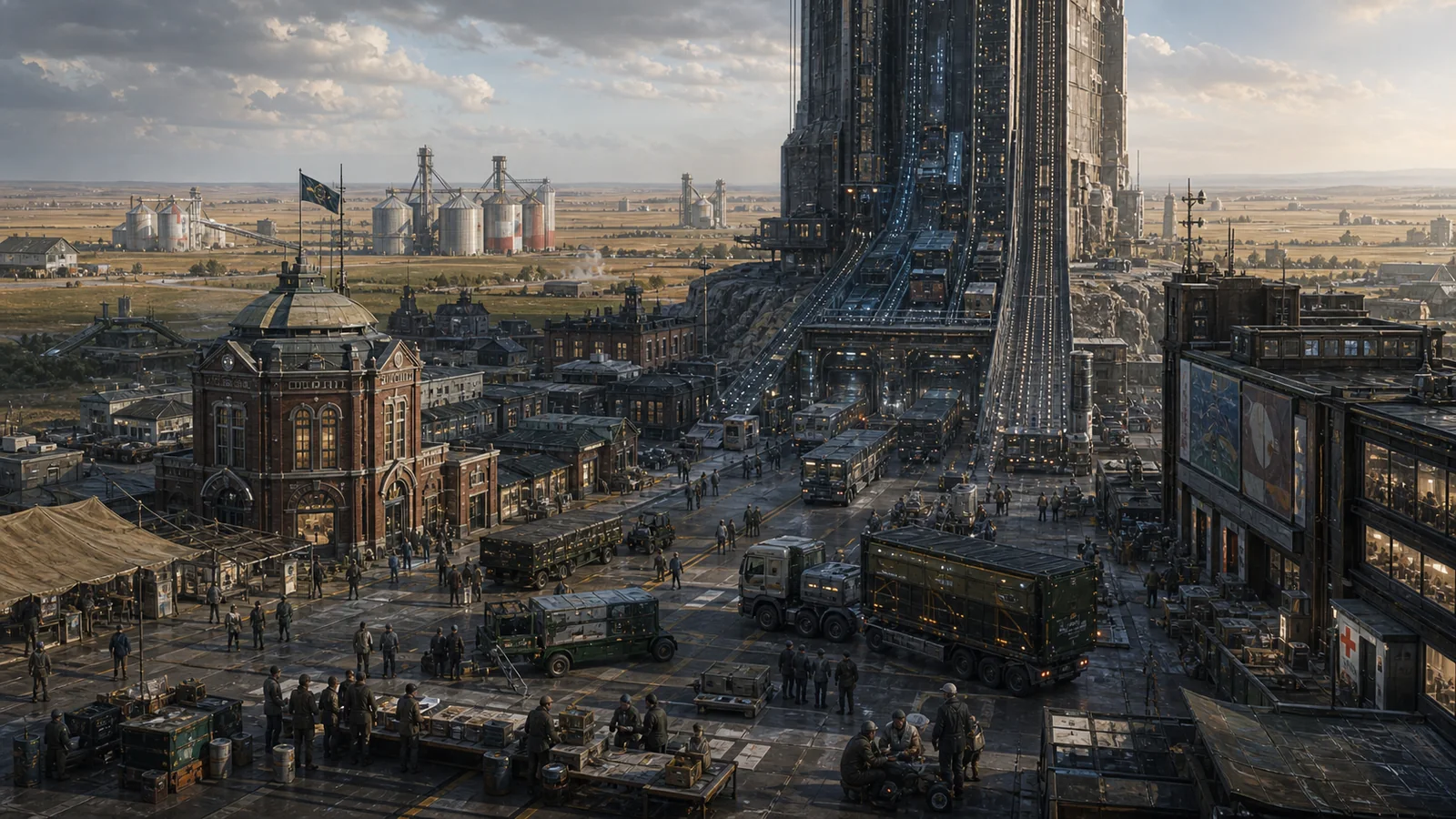
New Thessalia is an agricultural world in Geometry of Grace. Around Litchfield City, open prairie gives way to irrigation channels, access roads, machine sheds, and grain structures. The town stands at the foot of a freight elevator whose scale makes the settlement below it look small.
Landscape and settlement
The prairie around Litchfield is pale gold late in the growing season. Roads and irrigation works divide an otherwise expansive landscape. Farming and transport are visible together: the grain structures outside town belong to the same working geography as the freight yards and repair sheds nearer the elevator.
Litchfield is a particular settlement within New Thessalia. Its industrial surroundings and agricultural district provide the novel’s close view of the world; they are not a complete description of every community on the planet.
Ground and orbit
The elevator carries cargo between the surface and the freight array overhead. Its base complex, the yards, and the routes feeding them form a connected system. Access to one part matters because it makes movement through the others possible.
That physical connection gives freight infrastructure an immediate social importance. Local work and supplies depend on routes that extend beyond the farms and town. An idle crane or an interrupted road is a practical problem for someone whose living passes through it.
A lived-in world
New Thessalia is also a place of co-operative work, repair, local knowledge, and disagreement. Its inhabitants have reasons of their own for the choices they make. The companion article on culture and daily life follows those local relationships.
FOLLOW THE CONNECTIONS
Related articles
Also connected from
Pepper ↗Reading references
- Geometry of Grace — Chapter 9
Introduction view omits plot outcomes. Interpretive articles are readings of the fiction.